
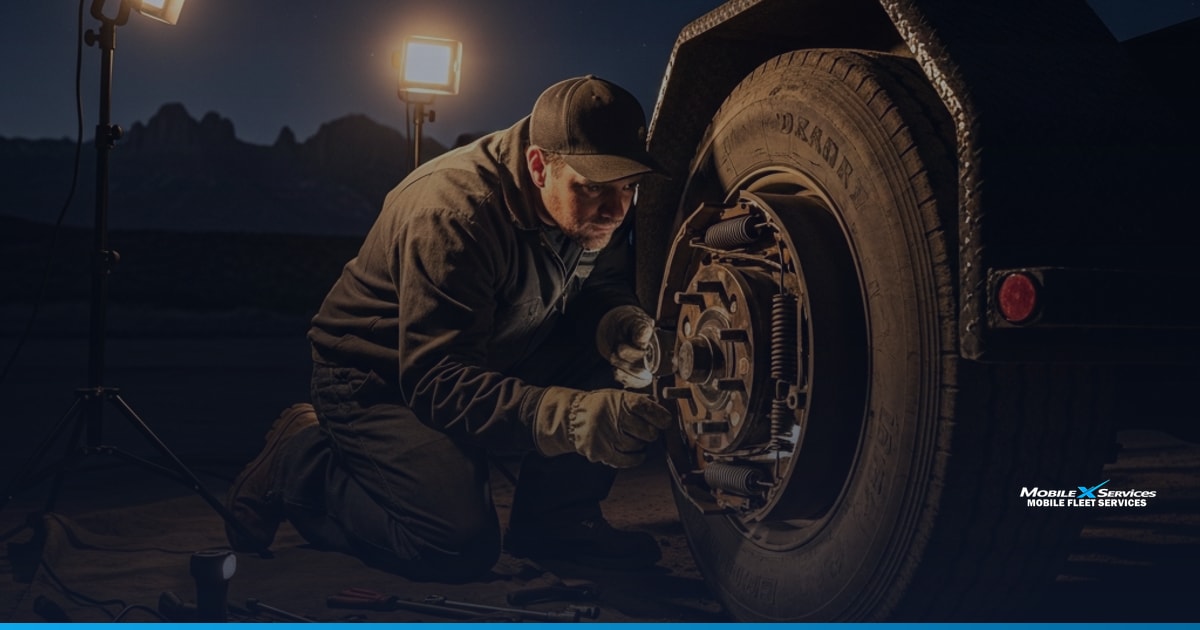
Brakes Are the #1 Reason Trailers Get Put Out of Service
According to CVSA roadside inspection data, brake-related violations consistently top the list of Out of Service defects for commercial trailers. A single DOT roadside inspection can shut down your trailer on the spot — no warning, no grace period. And under the CVSA's North American Standard Out-of-Service Criteria, you don't need all your brakes to fail. If 20% or more of your equipped service brakes have a defect that renders them inoperable, your trailer is out of service.
For a standard tandem-axle trailer with four brakes, that means just one bad brake can meet that threshold.
The good news: most brake failures don't happen without warning. Fleet managers who know what to look and listen for can catch problems long before a DOT inspector does.
The Warning Signs You Can't Afford to Miss
Sounds That Demand Attention
Your drivers are your first line of defense. Train them to report these noises immediately — not "next time the truck goes in":
- Squealing or grinding during braking: — worn brake shoes or shoes making metal-to-metal contact with the drum. If it's grinding, the friction material is gone.
- Rhythmic thumping or scraping: — often signals a cracked or warped brake drum. At highway speeds, this can progress quickly.
- Constant hissing from the trailer area: — a telltale sign of an air leak in the brake system. Under 49 CFR §570.57, a combination vehicle must not lose more than 3 PSI per minute with brakes released or more than 4 PSI per minute with brakes applied — either is a direct OOS trigger.
- Popping or clunking when the brakes release: — can indicate a sticking cam or a seized slack adjuster.
Any driver who reports one of these sounds and is told to "keep an eye on it" is one inspection away from a very expensive day.
Visual Indicators During Pre-Trip
A thorough pre-trip inspection takes less than five minutes on the trailer brakes. Look for:
- Excessive brake dust on the inside of the wheel: — especially uneven buildup, which indicates uneven wear across axles.
- Oil or grease on the drum or brake shoes: — immediate disqualification. Contaminated friction material cannot stop a loaded trailer reliably and is an automatic OOS violation.
- Cracked or heat-checked brake drums: — visible cracks on the drum face or hat area mean the drum is done. Running on a cracked drum risks catastrophic failure.
- Smoke or heat shimmer from a wheel end after driving: — brakes that drag or stick generate severe heat. A wheel that's noticeably hotter than the others is a dragging brake.
- A brake chamber or spring brake housing with visible damage: — cracked housings are an OOS violation. Spring brake canisters are under extreme tension and should never be disassembled in the field.
- Slack adjuster pushrod exceeding stroke limits: — if the pushrod travels more than the allowable distance before the brakes engage, the brakes are out of adjustment. This is one of the most common OOS defects DOT inspectors find.
Performance Red Flags on the Road
Brake feel and vehicle behavior are the most obvious warnings — and the most often ignored:
- Longer stopping distances than normal: — if it takes more road to stop the same load, the brake system has lost capacity somewhere.
- Trailer pulling to one side during braking: — one axle braking harder than the other creates a yaw force. On a loaded trailer, this is how jackknifes start.
- Air pressure slow to build or not reaching 90 PSI: — federal standard requires the system to build from 85 to 100 PSI within 45 seconds at governed engine speed. Failure to do so points to a compressor or governor problem.
- ABS malfunction lamp illuminated: — modern trailers have external ABS indicator lamps. A lit ABS lamp during a roadside inspection is a violation under 49 CFR §393.55.
- Soft or spongy brake pedal feel: — on hydraulic brake systems common to utility and flatbed trailers, spongy feel means air in the lines or fluid contamination.
What DOT Inspectors Actually Check
During a Level I or annual inspection, a DOT inspector will walk through the full brake system on your trailer. They're looking at:
- Brake chamber type and size: — mismatched chambers between axles is an automatic violation
- Pushrod stroke: — measured against published adjustment limits; out-of-adjustment brakes are the most ticketed defect nationally
- Brake lining thickness: — linings worn to or below the wear indicator are OOS
- Drum condition: — measured for wear, cracking, and heat damage
- Glad hands and air lines: — inspected for leaks, chafing, and secure connections
- Slack adjusters and camshafts: — checked for free movement and proper lubrication
- Breakaway/emergency system: — the spring brakes must automatically apply if air pressure is lost; inspectors test this
Every one of these items is covered under 49 CFR Part 393 (minimum equipment standards) and 49 CFR Part 396 (inspection and maintenance requirements). Annual inspections under 49 CFR §396.17 are required every 12 months — and the sticker better be current when an inspector walks up.
Why Trailer Brakes Degrade Faster Than Drivers Realize
Trailers take a beating. Unlike a truck cab, trailer brakes often go uninspected for months at a time. A few conditions that accelerate brake wear:
- Heavy or uneven loads: — overloading even one axle causes that axle's brakes to work harder than the others, wearing them out of sync
- Mountain grades in Utah: — I-15 between Salt Lake and St. George, the Wasatch grades, the climb into Price — repeated mountain descents heat brake drums significantly and accelerate lining wear
- Infrequent adjustment: — automatic slack adjusters are standard, but they can stick or bind, leaving brakes under-adjusted without any obvious warning
- Seasonal changes: — temperature swings in Utah can cause air line fittings to loosen and brake hardware to seize
The Real Cost of Ignoring Trailer Brake Problems
An Out of Service order doesn't just mean a repair bill. It means:
- The trailer parks where it sits: — no cargo movement until the violation is corrected and a new inspection is passed
- Downtime costs run $448–$760 per vehicle per day: based on 2024–2025 fleet industry benchmarks, including lost revenue and driver idle time
- Civil penalties: — general safety violations carry fines up to $18,758 per violation; employers who knowingly permit a driver to operate under an out-of-service order face up to $23,048 per violation (49 CFR Part 386, App. B)
- Liability exposure: — if a brake failure contributes to an accident, documented deferred maintenance becomes a serious legal problem
Catching a bad slack adjuster or a worn brake shoe at a scheduled appointment costs a fraction of what an OOS order costs — and a fraction of what an accident costs.
How MobileXServices Handles Trailer Brake Repairs
We come to your trailer — at your yard, your job site, or wherever it's parked. For Utah fleet operators running pickups and trailers, our appointment-based mobile service means:
- No towing: — a trailer with a brake problem shouldn't be moving far; we come to it
- No shop wait: — your trailer is serviced on your schedule, not whenever a bay opens up
- Straightforward pricing: — call for a quote upfront; no surprise shop fees or diagnostic charges
- Fleet scheduling: — we can inspect and service multiple trailers in a single visit; fleet customers get priority scheduling and fleet pricing
We service utility trailers, flatbed trailers, enclosed trailers, and the pickup trucks that pull them. We cover the Wasatch Front, Utah Valley, and surrounding areas.
Call (801) 449-1717 or email mobilexservices@gmail.com to schedule a trailer brake inspection or repair.
Frequently Asked Questions
How do I know if my trailer brakes are out of adjustment?
The most reliable method is to have a qualified technician measure pushrod stroke against the allowable limit for your brake chamber size. In the field, a trailer that takes noticeably longer to stop, or that pulls to one side when braking, is often a sign of out-of-adjustment or uneven braking. Pre-trip visual inspection — checking for excessive play in the slack adjuster — is also a useful but less precise indicator.
Can I adjust my own trailer brakes to pass a DOT inspection?
Automatic slack adjusters should self-adjust under normal operation, but they must be inspected and manually set by a qualified mechanic under 49 CFR §396.19 requirements. Incorrect adjustment can make the brakes worse, not better. If your trailer has manual slack adjusters, they must be adjusted by someone who knows the correct stroke limits for your specific brake chamber size.
How often should trailer brakes be inspected?
At minimum, once every 12 months under 49 CFR §396.17. In practice, high-use trailers — especially those running mountain grades — benefit from a brake inspection every 6 months or every 50,000 miles, whichever comes first. Any time a driver reports unusual sounds, pulling, or longer stopping distances, that warrants an immediate inspection regardless of the maintenance schedule.
What's the difference between electric trailer brakes and air brakes?
Most utility and flatbed trailers towed by pickup trucks use electric trailer brakes — controlled via a brake controller in the cab. These use electric magnets to actuate the brake shoes and are common on trailers up to about 30,000 lbs GVWR. Air brakes are standard on heavier commercial trailers and use compressed air from the truck's air supply. Both systems have their own inspection criteria and failure modes, and both are covered by FMCSA regulations when the trailer meets the CMV weight thresholds.
Does MobileXServices service air brake trailers?
Yes. We work on both electric brake and air brake trailer systems. Call (801) 449-1717 to describe your trailer setup and confirm service coverage for your location before scheduling.