The Short Answer
If you think commercial vehicle rules only apply to semis and big rigs, think again. Under FMCSA regulations, a vehicle doesn't need to be large to qualify as a Commercial Motor Vehicle (CMV) — and once it does, specific safety, inspection, and maintenance requirements apply to your operation.
How the FMCSA Defines a Commercial Motor Vehicle
The Federal Motor Carrier Safety Administration uses a specific set of criteria to determine whether a vehicle is a CMV. A vehicle is classified as a commercial motor vehicle if it meets any one of the following:
- Gross Vehicle Weight Rating (GVWR) of 10,001 lbs or more: — this is the vehicle's rated maximum weight, not its actual weight when empty
- Combined GVWR of 10,001 lbs or more: — the towing vehicle plus the trailer, combined
- Designed or used to transport more than 8 passengers: (including the driver) for compensation — that is, 9 or more paying passengers
- Designed or used to transport more than 15 passengers: (including the driver) not for compensation — that is, 16 or more passengers without pay
- Used to transport hazardous materials: in quantities requiring placards under federal hazmat regulations
The full statutory definition is at 49 CFR §390.5.
The Trailer Rule Most Operators Miss
Here's the one that catches a lot of Utah fleet operators off guard:
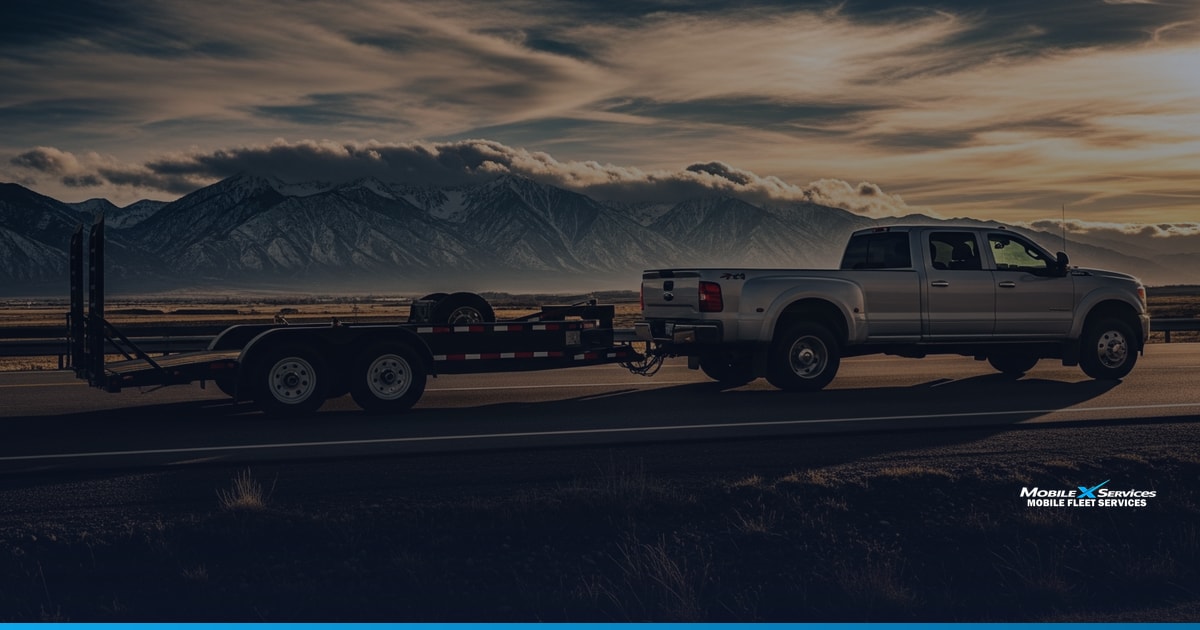
If your pickup truck has a GVWR under 10,001 lbs, but you're pulling a trailer that pushes the combined GVWR to 10,001 lbs or more, that combination is classified as a commercial motor vehicle.
This means a half-ton or three-quarter-ton pickup that would otherwise fly under the radar is now subject to FMCSA requirements the moment it's hooked to a trailer and the combined weight crosses that threshold.
So if you're regularly towing:
- Utility trailers loaded with equipment
- Flatbed trailers with heavy materials
- Enclosed cargo trailers near or over capacity
- Equipment trailers with skid steers, ATVs, or machinery
...you may already be operating a CMV without realizing it. Utah operators in construction, landscaping, oilfield services, and agriculture run these combinations every day.
What GVWR Means (and Why It Matters)
GVWR stands for Gross Vehicle Weight Rating — it's the maximum weight a vehicle is rated to carry, set by the manufacturer. It is not the actual weight of the vehicle. A pickup with a GVWR of 9,900 lbs might weigh far less when empty, but its rating still determines how it's classified in combination with a trailer.
The combined GVWR is simply the GVWR of the tow vehicle added to the GVWR of the trailer. If that number hits 10,001 lbs or more, the combination is a CMV under FMCSA rules — regardless of what the vehicles actually weigh on a given day.
When Does a CDL Become Required?
Crossing the 10,001 lb combined GVWR threshold makes your vehicle combination a CMV — but crossing 26,001 lbs triggers an even bigger requirement: a Commercial Driver's License (CDL).
Under 49 CFR §383.91, a Class A CDL is required when:
- The combined GVWR of the towing vehicle and trailer is 26,001 lbs or more, AND
- The trailer being towed has a GVWR of more than 10,000 lbs
This threshold catches a lot of operators off guard. A heavy-duty pickup with a GVWR around 11,000–14,000 lbs hooked to a loaded equipment trailer rated at 14,000–16,000 lbs can easily hit 26,001 lbs combined — requiring the driver to hold a valid Class A CDL.
Driving a vehicle combination over 26,001 lbs without the appropriate CDL is a serious federal violation. It can result in:
- Immediate placement Out of Service
- Substantial fines for both the driver and the operating company
- Increased liability exposure in the event of an accident
- Negative impact on your carrier safety rating
If your drivers are regularly operating truck-and-trailer combinations near or over that threshold, CDL compliance should be part of your review — not an afterthought.
What Changes When You're Operating a CMV
Once a vehicle crosses into CMV territory, FMCSA regulations kick in. These include requirements around:
- Vehicle inspection and maintenance: — systematic inspection programs, regular checks of brakes, lights, tires, coupling devices, and safety equipment
- Driver qualifications: — CDL required at 26,001 lbs combined GVWR or more (see above)
- Hours of service: — limits on how long drivers can operate without rest
- Roadside inspections: — DOT inspectors can pull you over and place your vehicle Out of Service for violations
The maintenance side is where many smaller fleet operators get caught. Brake defects, lighting failures, and wiring issues are among the most cited violations — and they're all preventable with routine on-site maintenance.
The Trailer De-Rating Option Most Operators Don't Know About
If it's the trailer's GVWR that's pushing your combination over the 10,001 lb or 26,001 lb threshold — and your actual loads don't require the trailer's full rated capacity — there is a legitimate option worth knowing about: requesting a GVWR de-rating from the trailer manufacturer.
Here's how the process generally works:
- Contact the trailer manufacturer: with your trailer's VIN and a request to reduce (de-rate) the GVWR to a lower value
- The manufacturer reviews the request: to confirm the trailer's structural design, axles, tires, and components can safely support operation at the lower rating
- If approved, a new compliance label: — sometimes called a VIN weight sticker or certification plate — is issued reflecting the reduced GVWR
- You install the new label: on the trailer, and the updated GVWR becomes the official rating for regulatory, registration, and insurance purposes
This is a real and recognized process. It's not a workaround — it's a manufacturer-certified change to the vehicle's official rating, supported by federal vehicle safety standards. Once the new label is in place, you'll also want to update the trailer's registration with the Utah DMV to reflect the new GVWR.
Important caveats to understand:
- De-rating is only appropriate when the trailer will genuinely be operated at or below the new, lower GVWR. If you're loading the trailer to its original capacity, the de-rating creates a false record and increases your liability.
- Not every manufacturer offers this service, and some charge a fee
- The structural assessment is done by the manufacturer — they will not approve a de-rating if the trailer's components aren't designed to safely carry the load at the lower rating
- Some states have their own rules around re-registration after a GVWR change, so check with your local DMV
For operators who are genuinely running light loads and simply got tagged by a high factory GVWR rating, de-rating can be a clean, cost-effective solution that removes the CMV or CDL obligation — without compromising safety.
Why This Is Especially Relevant for Utah Fleet Operators
Utah's construction, landscaping, oilfield, agricultural, and service industries are full of pickup-and-trailer combinations that cross the 10,001 lb threshold on a regular basis. If your crew is hauling heavy trailers to job sites across the Wasatch Front, Utah Valley, or out to rural areas of the state, FMCSA rules likely apply — and your vehicles need to be maintained to those standards.
That means functional brakes on both the tow vehicle and the trailer, working trailer lights and harnesses, properly functioning breakaway systems, and drivers who understand the weight thresholds they're operating under.
Staying Compliant Without the Headache
You don't need to overhaul your operation — you need to stay ahead of the maintenance items that get vehicles cited. MobileXServices handles the on-site repairs that keep your Utah pickups and trailers inspection-ready:
- Brake pad replacement: — on-site labor, done at your location
- Trailer lights and electrical: — harness repairs, brake lights, marker lights
- Trailer breakaway system service: — testing and replacement
- Battery and alternator service
We come to your yard, your job site, or wherever your equipment is located in Utah. No towing, no shop trip, no lost workday.
Call (801) 449-1717 or email mobilexservices@gmail.com to get on the schedule.
Frequently Asked Questions
Does my pickup truck count as a commercial vehicle?
Your pickup qualifies as a commercial motor vehicle if its GVWR is 10,001 lbs or more on its own — or if your truck combined with a trailer reaches a combined GVWR of 10,001 lbs or more. Many half-ton and three-quarter-ton pickups fall under 10,001 lbs individually but cross the threshold when towing a loaded trailer.
Do I need a CDL to tow a heavy trailer with my pickup?
A Class A CDL is required when the combined GVWR of your truck and trailer reaches 26,001 lbs or more, and the trailer's GVWR exceeds 10,000 lbs. If your combination stays between 10,001 and 26,000 lbs, you're operating a CMV but a CDL is not required — though all other FMCSA safety and maintenance regulations still apply to your operation.
Can I lower my trailer's GVWR to avoid CDL or CMV requirements?
In many cases, yes. You can contact the trailer manufacturer and request a formal GVWR de-rating. If the trailer's structure, axles, and components support operation at the lower weight, the manufacturer will issue a new compliance label reflecting the reduced GVWR. This is only appropriate if your actual loads genuinely stay under the new rating — it is not a workaround for a trailer that is regularly loaded to its original capacity.
What happens if I operate a CMV without proper compliance?
Penalties include immediate Out of Service placement, substantial fines for both the driver and the company, and negative impact on your carrier safety rating. Operating a vehicle over 26,001 lbs combined GVWR without a valid Class A CDL is a serious federal violation with significant financial consequences for both the driver and the business.
Do I need a DOT number if my pickup-trailer combination crosses 10,001 lbs?
If your CMV operates in interstate commerce — crossing state lines — a USDOT number is generally required. Some intrastate Utah-only operations also require one depending on total weight and cargo type. Check with the FMCSA directly or consult a transportation compliance professional to confirm your registration obligations.